
THE OLIVE MOTH: DAMAGE AND CONTROL METHODS
The Olive Moth Is Also Known as Margaronia
Its scientific names are Palpita vitrealis and Palpita unionalis. This is a widespread pest in Italian olive-growing regions. Its presence is cause for concern, as it can damage both the foliage of olive trees and the drupes — that is, the olives. Even though the insect is nocturnal, the adult stage is easy to recognize, as the moth has a very distinctive appearance. The actual damage, however, is not caused by the moth itself, but mostly by the larvae during their various growth stages.
In this article, we will take a closer look at this olive pest, study its biological cycle, and understand how to eliminate it from olive groves.
Appearance of the Olive Moth (Margaronia)
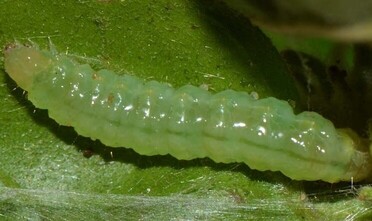
The adult olive moth has a slender shape, with a wingspan ranging from 2.5 to 3 cm. Its appearance somewhat resembles the Anglo-French Concorde aircraft. The wings are white, transparent, and shiny, with pearly reflections. Their front edge is hazelnut-colored. Male specimens can be distinguished from females by a tuft of elongated scales at the end of the abdomen. The larvae go through six developmental stages. When they first hatch, they are only slightly larger than the egg that contained them. Their color is yellowish, with a body covered in bristles located on black-colored tubercles. When mature, they have a small head, with the rest of the body gradually thickening toward the middle and tapering again toward the tail end. Their color is bright green, with a yellowish head. At full development, they reach about 2 cm in length. Before turning into pupae, they shorten and thicken, changing color to brown.
Damage Caused by the Olive Moth

The damage to olive trees is significant, as both vegetation and ripening olives can be affected. The harm is caused by larvae at different developmental stages. They feed on the leaves, especially targeting new apical shoots — particularly suckers and water sprouts. Fourth-stage larvae can also feed on olives, sometimes exposing the pit.
How to Protect Olive Trees from Margaronia
To protect olive trees from the olive moth, it is essential to ensure a high level of biodiversity in the olive grove. The lepidopteran has various natural enemies, especially among chalcid wasps (Hymenoptera Chalcidoidea) and parasitic flies (Diptera). Balanced pruning and fertilization also help, as they limit the growth of new vigorous shoots, which can prevent heavy infestations. Special attention should be paid to the regular cleaning of water sprouts, as these are among the moth’s preferred sites.
How to Eliminate Olive Moth Larvae
Among the various organic remedies against pests, the most effective one for the olive moth is Bacillus thuringiensis var. kurstaki. The product works best on young larvae, so a good time to apply it is in summer when several larval stages overlap. Vegetation should be thoroughly and evenly sprayed in the evening hours. The Bacillus thuringiensis acts by ingestion, so it’s essential that the larvae eat leaves that have been sprayed.
Source : coltivazionebiologica.it